
Download
Premiere
Filmography
Home
Contact
35 mm, Dolby Stereo, colour / black & white, 112 min.
|
|
Cast & Crew Download Premiere Filmography Home Contact |
|
|
A film of Harald Bergmann 35 mm, Dolby Stereo, colour / black & white, 112 min. |
||
 |
 |
||||
|
Scardanelli is the poet Friedrich Hölderlin as a madman. He lives in a small room in the tower of Tübingen. The film reconstructs the second half of his life on the basis of all the available witness reports. No word, no sentence in this film is invented. The scenes are reconstructed according to the original documents. |
|||||
|
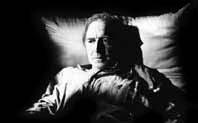
»The poor Hölderlin was taken away this morning to
be brought back to his relatives. He made all
efforts to escape, but the man who took care of
him pushed him back into the coach. Hölderlin
shouted that Harschierers are kidnapping him and
made more efforts. He scratched the man with his
enormously long fingernails, so that he was
covered all over with blood.« (Princess Caroline von Hessen-Homburg, 11. 9. 1806) |
 |
||||
| Hölderlin was brought to the asylum of Doctor Autenrieth in Tübingen and stayed there for seven months, until he was given, considered as incurable, to the carpenter Ernst Zimmer. The poet lived finally another 36 years, nursed by Zimmer and his daughter Lotte, in a small room over the Neckar river, playing piano, making drawings and creating more poetry. When he was given an edition of his former poetry, he responded: | |||||
| »Yes, the poems are mine, I wrote them, but this name is a fake. I've never called myself Hölderlin, but Scardanelli!« |

| ||||
| The film is a portrait of the mad artist. Scenes are shot in a black and white of a Murnau silent movie of the twenties, animations with music and recitals show the late poetry of the poet, his behaviour in the meetings with his visitors, how he was playing and improvising for hours on the piano. | |||||
|
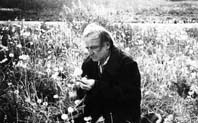
»I am convinced that Hölderlin was not that unhappy
in his last thirty years, as the professors of
literature want to make us believe. Being allowed
to dream in a modest nook without being obliged
to fulfill permanently all the demands of the
world is surely not a martyrium. People only like
to see it this way.« (Robert Walser) |
 |
||||